Book Reviews

‘The best moments in reading are when you come across something - a thought, a feeling, a way of looking at things - which you had thought special and particular to you. And now, here it is, set down by someone else, a person you have never met, someone even who is long dead. And it is as if a hand has come out, and taken yours.’ Alan Bennett

“Many a book is like a key to unknown chambers within the castle of one’s own self.” ― Franz Kafka

Showing posts with label photography. Show all posts

Friday, 6 February 2015

A review from pre-blog days - Footsteps - Katharine McMahon

I'm sharing a book review I wrote before I started my book blog and which originally appeared elsewhere. My 'before the blog' review posts are inspired by Karen at My Reading Corner and Janet at fromfirstpagetolast.


(originally read and reviewed in 2009, I was given my copy of this novel by a colleague)

Synopsis
The women in Helena Mayrick's family have always led secretive and tragic lives, and when Helena's comfortable marriage is devastated by her husband's violent death, it seems that she, too, is locked into the cycle.

Helena is invited to research a book on her grandfather, H. Donaldson, the celebrated Edwardian photographer. At first she is reluctant to immerse herself in family history, particularly as Donaldson's relationship with her grandmother, Ruth, is shrouded in mystery and turmoil.

But gradually, as the story of enigmatic Ruth and the elusive, passionate Donaldson unfolds, Helena finds that the past, like the present, was shaped by cruel dilemmas and the demands of love...

~~~~~

I was given this novel by a colleague as a recommendation, and I'm so glad I was! It is the most enchanting, beautiful novel I've read for awhile. Wonderfully written, it tells the story of Helena Mayrick close to the present day, trying to overcome tragedy and embarking reluctantly at first on writing a book about her relation Donaldson, who was a famous photographer, and of her Grandmother Ruth Styles in the early part of the twentieth century, with a chapter alternately set in the present and then the past throughout the book.


Ruth Styles is the lynchpin to the whole novel and the most intriguing and devastating character, to whom all else somehow relates. She grows up by the sea in Suffolk, in a small village, and it is this place which shapes much of the lives of those involved. Young Ruth is intelligent, bright, and sparky, and has a profound and lasting effect on many around her, most noteably on Donaldson, the photographer who comes to Westwich and so begins his lifelong fascination with Ruth. As a reader, I was intensely curious and compelled to read on and find out what would happen to her, and so much does!

There is a marvelous sense of place within the novel, and it is clear the bearing the proximity of the sea has on several of the characters. The book is about the repercussions of the past; about love, forbidden love, lost love, unfulfilled love; it is about the draw of a particular landscape and how it can free or restrict a person, and it is about choices and fulfillment of potential, especially for women, which is a key theme of this author. Highly recommended.

Monday, 20 May 2013

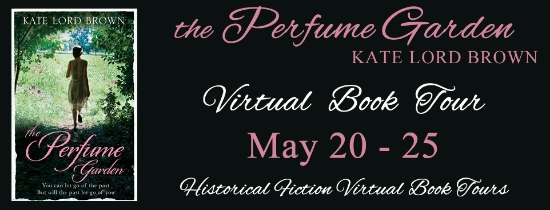
The Perfume Garden - Kate Lord Brown


'Some people's memories lie in images or songs, but for Emma it was always fragrance.'

Emma Temple is coming to terms with the fact that she is expecting a baby with her long-time love Joe, yet they are no longer together. Joe has been having an affair with Delilah, a friend from his past who is also the third partner in the highly successful perfumery business they all run together, which was established by Emma's beloved late mother, Liberty Temple. Emma is introduced to us in autumn of 2001, alongside her close relatives; Grandmother Freya and her Great-Uncle Charles. Emma is trying to accept that things seem to be over with Joe, yet she must tell him about the baby. He is away on business in New York with Delilah. In another strand to the narrative, it is 1936 and Charles, along with his friend Hugo, has arrived in Spain leaving behind their studies in Cambridge to photograph, report on and support the struggles of the International Brigades in Spain, fighting Franco's forces in the bitter civil war. We are also introduced to a young Spanish couple, Jordi and Rosa, and to a certain photographer by the name of Robert Capa.

I am always interested in fiction that deals with the Spanish Civil War, and soon after starting to read, I found myself getting carried off into this story, first entranced by the young photographer capturing a famous image of a falling soldier, then swept into the passion and pain of the struggle of the people supporting what they believed in and fighting as their country was torn apart. The young English nurse, facing the terrible tragedies playing out every day, in such close proximity to death, and her brother, capturing the images of war.

The modern day story involving Emma parallels the historical narrative; it is one of pain and loss, too, and of her trying to find a way forward and a new start. As Emma takes steps towards a new future for herself, heading to Valencia with the key that was left to her amongst her mothers letters, she finds an old, neglected villa, and a new freedom in her life, breaking out of the recent difficult times: 'In Spain, Emma felt like she was coming out of hibernation.' At the same time she opens up the door to the past within her family, uncovering secrets from the time her grandmother Freya spent in Spain during the civil war as a nurse. For Freya, and for her brother Charles, the painful memories from their days spent in Spain are difficult to deal with to this day, and as Emma learns more about Freya's past, she begins to understand why. 

I found the storyline gripping, with short chapters taking us back and forth in time from Emma's days in modern-day Spain to the depths of the tragic civil war. I was easily tempted to read just one more chapter to discover what had happened in the other strand of the story and I was absorbed by this depiction of a family who, through the generations, had found and lost love. 

The descriptions of Spain, the sights and sounds, the people and traditions, are very evocative and vivid, enabling me to picture the scenes, to imagine the aromas. I feel that Kate Lord Brown writes with an evident passion about her subjects here, and this enthusiasm and convincing depiction of events drew me further into the lives of the characters and their stories, and I cared about them and their romantic relationships and friendships. 

This is a beautiful novel about love and separation, war and idealism, secrets and memories, about the terrible tragedies of wartime that leave mental scars and the hope and optimism that a new start and a new home can bring. Fragrance is a key theme in the story, the idea of it evoking memories. The storytelling in this novel has been compared to that of Kate Morton and I feel that this is an accurate comparison; a dual time frame story that is handled well, with themes of love, family history and secrets; this all combines to make The Perfume Garden a very involving, vivid, romantic and moving read to lose yourself in. 

Published by Corvus, an imprint of Atlantic Books

Thank you to the author, the publisher and to Amy at Historical Fiction Virtual Book Tours for the opportunity to read and review this novel.


~~~
Visit my blog again tomorrow to read a lovely guest post by author Kate Lord Brown!
~~~


Exciting news! 

Kate Lord Brown has written a short prequel to The Perfume Garden, THE LAST ROSE OF SUMMER, and you can download it for free from today for a limited time, as a taster for The Perfume Garden - here are the links:  

About the author


Kate Lord Brown 1Kate grew up in the wild and beautiful Devon countryside. After studying philosophy at Durham University and art history at the Courtauld Institute of Art in London, she worked as an international art consultant, curating collections for embassies and palaces in Europe and the Middle East. She is married to a pilot, and lives with her family in Qatar. Her debut novel ‘The Beauty Chorus’ was inspired by the many hours she spent on airfields in the UK, and the experiences of pilots in her family during WW2. Her second novel about the Spanish Civil War, ‘The Perfume Garden’, draws upon the years she lived in Spain, and will be published in paperback in April 2013 by Atlantic.

For more information please visit Kate’s website and blog. You can also find her on Facebook, Twitter and Pinterest. You can also check out the Facebook and Pinterest page for The Perfume Garden.

Friday, 23 November 2012

The Painted Bridge - Wendy Wallace


It is 1859 when Anna Palmer is cruelly incarcerated against her will by her husband Vincent in a Victorian asylum near London named Lake House. This private asylum houses genteel women supposedly needing a rest and a cure, those who have delicate sensibilities. Having realised what has happened to her, and what Lake House actually is, Anna immediately sets about trying to prove there is nothing wrong with her and that she doesn’t belong there and should be allowed to leave immediately. She appeals unsuccessfully to her uncaring husband to let her return home.

Lucas St Clair is a physician working at the asylum, employing the very new medium of photography in his work with the patients, believing that it may perhaps be used to shed light on the health of their minds.

Anna is subject to cruel treatments in the asylum that were common in those days, supposedly in the name of a cure. Initially she wants little to do with the other residents, but slowly she lets her guard down and finds more in common with some of them than she first expected. Alongside some companionship with the owner’s daughter, and her meetings with Lucas St Clair, they are of course the only people who can help reduce her feelings of isolation and from whom she can gain strength and solidarity.

I was gripped by the storyline right from the start. I felt sad at the helpless situation Anna found herself in, and angry at the ease with which she was locked away there by her husband. The author highlights the cruelties and injustices of the system and of society prevalent in those times, leaving women with little or no say in their own destiny, and locked away for feeling low or anxious, or just not behaving as expected. The writer caused me to care about Anna and share her feeling of being trapped, and I was willing her to find an escape somehow.

I loved the author’s use of language, and the names she created for some of the characters at Lake House struck me as perfect.

There is beautiful and convincing period detail throughout this intelligent, perceptive historical novel, and the author has evidently researched her topics well, but is never heavy handed with the details. I found it particularly interesting to read about this early use of photography, the processes involved, and this theory that it may enlighten a doctor as to the mental health of patients. Will Anna be able to prove her sanity? What is the truth about her past, and her husband? The lines between truth, reality and fact become blurred until we are unsure quite what to believe at times.

The hardback edition of this novel has beautiful endpapers which complement it very well.

This is a fascinating, emotional and compelling debut novel with engaging characters and a strong storyline throughout. This is a book that I would definitely read a second time. I am really looking forward to reading the next novel by this author. 


Published by Simon & Schuster

You can follow the author on twitter @slangular and visit her website here.

Thank you very much to the publisher for the opportunity to meet this author at their book bloggers event recently. Thank you very much to Wendy for being so friendly and happy to discuss her book and her work.