Book Reviews

‘The best moments in reading are when you come across something - a thought, a feeling, a way of looking at things - which you had thought special and particular to you. And now, here it is, set down by someone else, a person you have never met, someone even who is long dead. And it is as if a hand has come out, and taken yours.’ Alan Bennett

“Many a book is like a key to unknown chambers within the castle of one’s own self.” ― Franz Kafka

Showing posts with label America. Show all posts

Friday, 15 August 2014

The Invention of Wings - Sue Monk Kidd - Guest Book Review


Published by Headline

Guest book review by Susan Maclean

You may have come new to this author, or you may have read The Secret Life of Bees or The Mermaid Chair already.  Or you may have noticed a blurb from either inside or outside the cover of this novel which says “A powerful, sweeping novel inspired by real events, and set in the American Deep South in the nineteenth century”.  However Sue Monk Kidd crossed your radar, you will pick a winner if you read this. 

A fictional account of  the real lives of two sisters, Sarah and Angelina Grimke of Charleston, South Carolina; it contains a devastating portrayal of slavery in the Southern States of America, and it also brings to our attention the story of these two sisters who fought for the abolition of slavery and more.  And only fictional in that it is told as a story, rather than as a block of information.  It’s well written, and it had me just wanting “another chapter” before I laid the book down. 

It’s told in alternate chapters by Sarah Grimke and by Hetty Handful,  the slave who is given to Sarah on the morning of her eleventh birthday as her handmaid.  Racked with guilt about the way slaves are treated, Sarah wishes this gift be taken back; she does not want her – only to be laughed at by her family.  Sarah would like to be a lawyer, like her father, but as “just a girl” this dream will never come to fruition either.  In both cases, her wishes are ignored,  so Hetty becomes her companion, who she teaches, secretly, to read and write (against the law).  For Sarah, there is a great and devastating punishment for this crime; she is never allowed to read a book from her father’s library again – so this means no more reading, ever.  She must therefore forgo any dream of entering a man’s profession, since women of her class should marry well and run a good home.  As she grows to adulthood, and is shown off in society to seek a husband, something happens that will change her life.

The book is divided easily into chunks headed either Sarah or Hetty, so that you know immediately whose  voice you are listening to.  It’s  fascinating to note how these two different women view the same occurrences and how neither are free in the way we would understand freedom now.

The Invention of Wings covers a period prior to the American Civil War, from 1803 to 1938, and will, perhaps, open your eyes to how it was for house slaves then, the ill-treatment doled out to them as a matter of course, and, interestingly the real thoughts of those slaves, whilst bobbing the knee and repeating “yes’m”.  The abject cruelty towards fellow humans rather takes the breath away until we remember that slavery is not yet dead, and goes on all over the world.  You can read this either as a ripping novel, or as an account of the truth.  Either way, I think you may enjoy the journey.

When you think of the abolition of slavery and the emancipation of women, the name Grimke does not spring to mind;  and yet, for what they did, Grimke should be a household name in the world biography of women.  Please don’t forget to read the author’s note at the end of the book – how she found out about the Grimkes, how she decided to write about their lives, and how a young slave called Hetty became the other voice of this book.


Many thanks to Susan for reading and reviewing this novel for The Little Reader Library! Susan blogs at Mac-Adventures (with Books!), do visit her fab blog too!

Wednesday, 6 August 2014

Black Irish - Stephen Talty - Guest Book Review


Published by Headline Review

Guest book review by Lisa Sargison


Initially the book seemed to move quite slowly, taking its time to introduce the people and events.  There seemed to be an awful lot of words spent on scene setting and helping us to understand just what a detective named Absolom Kearney would want in Buffalo. The writing is good and is, on the whole, an easy read.  There are excellent descriptive passages setting the scene of Buffalo, a city that not many will know well.  However at times the descriptive passages are badly placed in that the story is racing along and Stephan Talty has you gripped to find out where we are heading and he stops to briefly describe a scene.  WHY??? It often adds little to the story, and where it does, it would be better placed at the end.  Our detective, Absolom, spends time reflecting on her past, her future and the events that have led her back to her childhood home in Buffalo.

As to story, I found this to be great.  It was tense, spoilt only by the interspersal of the descriptions already mentioned, and followed a well thought out plot.  There was enough talk about police work to enable you properly understand the right way (and more importantly!) the wrong way of doing things.  Our heroine is a tough girl, who has much to deal with - her own demons never far from the surface and often an unhealthy influence on her decision making - but that is what makes the story interesting and gives the character that likeability factor! There is a lot of Irish/American history and background tied up in the story, with an element of the IRA as well.

I would say that this will be something for readers of the grittier crime novels, as some of the descriptions are somewhat graphic.  I would also say that the best way to read this is in a couple of sittings - I found that my first read of it didn’t do it justice but my second read was far more satisfying and I found that I was able to keep focused on the story better. Since reading this, I have found that the author intends that this is the first in a series of books with the detective Absolom and so perhaps he can be forgiven for including such a large amount of scene setting.


Many thanks to Lisa for reading and reviewing this novel for The Little Reader Library!

Friday, 1 August 2014

The Purchase - Linda Spalding - Guest Book Review


Published by Sandstone Press

Guest review by Mandy Jenkinson

Quaker widower Daniel Dickinson is driven by his community from his native Pennsylvania after he marries a young orphan Methodist girl following the death of his wife. He sets off to build a new life for his family in Virginia and almost by accident he acquires a young slave boy. This impulsive act sets off a chain of tragic and ever more complicated set of events that profoundly affects both his life and that of his children. Deeply horrified by slavery he yet finds himself caught up in its snares, and can never quite manage to break free.

This is an extremely powerful and moving story with some unforgettable characters. Daniel himself is a good and moral man, but everything he does somehow goes wrong. Whether that is due to any intrinsic weakness in his character, or whether it’s a destiny he can’t fight against, is left to the reader to decide. For all his good intentions, he causes irreparable harm to those who are dear to him. Set in pre-abolition America, it’s an evocative and atmospheric account of everyday slavery and its effect on slave-owners. 

There’s some raw and powerful writing here. The author’s commanding use of language makes for an unforgettable portrait of a time and a place. Skilfully paced, and often surprising, the story moves on to its inexorable end and explores how devastating the consequences of one split-second decision can be. It’s an unremittingly bleak novel, with very few moments of joy or redemption, even though there is love and loyalty to be found here as well. Serious themes of family, religion and conscience pervade every page and I found it both totally absorbing and totally compelling.


Loosely based on the author’s own ancestors, and painstakingly and thoroughly researched, this is a book that will remain with me for a long time, and one that I very much enjoyed. 


Many thanks to Mandy for reading and reviewing this novel for The Little Reader Library. Mandy is an omnivorous reader who enjoys reviewing, for newbooks magazine as well as elsewhere, and enjoys discovering new authors.

Friday, 21 February 2014

Guest Book Reviews Special!

Three new guest reviews here - and a massive thank you to three lovely guest reviewers for reading these novels and reviewing them for The Little Reader Library. 


Under the Same Stars by Tim Lott
published by Simon & Schuster
guest book review by Angi Holden

It’s 2008. The world is in the grip of a banking crisis and America, still recovering from the ravages of hurricane Katrina, has elected its first black president. Against this background of global meltdown, Salinger Nash and his older brother Carson embark on a road trip in search of their estranged father.
Salinger – named after JD, author of Catcher in the Rye – is forty, an artist who lives with his girlfriend Tiane in London. He has suffered from phases of intense depression since adolescence. Carson – named after McCullers, author of The Ballad of the Sad Café – followed their father to the States many years ago and has made an all-American life for himself. He is a born-again Christian, unrelentingly optimistic.
Their relationship is distant, strained - Cain and Abel for modern times. The last time they met was at their mother’s funeral. They come from very different cultures and have equally different outlooks on life. It is with justified foreboding that Salinger sets off with his brother across the Southern States – from Carson’s home in New Orleans, through the Texas plains and on to New Mexico. Sibling rivalry confined in Carson’s shiny new Lexus is not an attractive proposition. There are old misunderstandings; there are new ones. And all the time Salinger’s e-mails and phone messages to Tiane go unanswered.
This is a fascinating road trip. A touch of Thelma and Louise, a nod to On the Road, even a short stretch by motorbike, to evoke memories of Easy Rider. Salinger is an intriguing character; deeply flawed yet likeable. He is capable of great trust and compassion even whilst delivering the cynical observation of an outsider.

Under the Same Stars is a tender, unflinching exploration of the childhood baggage we carry into our adult lives. Do the brothers find their father? Do they resolve their differences? And what is the significance of the photograph Salinger carries in his pocket. Well, I’m not going to tell you. You’ll simply have to read it, and I recommend you do.

Views of other bloggers - Dog Ear Discs |

~~~~~


The Outline of Love by Morgan McCarthy
published by Tinder Press
guest book review by Josie Barton

"It started with obsession"

Persephone Triebold escapes the isolation of her home in the Scottish Highlands and at the earliest opportunity heads for university and the bright lights of London, where she immerses herself wholeheartedly into student life. She hopes that the lure of new friends, endless parties and the promise of grand passion will grant her the excitement she so desperately craves. When she comes into contact with the famous writer, Leo Ford, and gets drawn into his mysterious world, the fascination she feels for him and his lifestyle soon becomes an overriding infatuation. However, Leo harbours a secret from his past which, if exposed, threatens to damage his growing reputation.

The description of student life in London is nicely done and in many ways seems to be a rather good interpretation of being young and carefree in a lively environment. However, Persephone’s character is rather harder to analyse, she is strangely immature in many ways, which somehow makes her attachment to Leo Ford rather unrealistic. The events of the past which threaten to engulf their unlikely relationship seem more of a damp squib rather than a huge revelation but the dénouement when it comes does seem to make sense in an understated sort of way.

Overall, this is a competent coming of age story; however, it’s not literary dynamite as the characters are not compelling enough to drive the narrative completely, and even though the story gets off to a good start, for me it rather fizzled out somewhere in the middle. I would give the book 3 out of 5 stars.


Views of other bloggers - Fleur in her World | Our Book Reviews |

~~~~~


Dark Possession by Carol Goodman
published by Ebury Press
guest book review by Wendy Rowley

This is the third book in the Fairwick Chronicles.  The first book, Incubus, I enjoyed immensely however I was disappointed with the second one, Water Witch.  Therefore it was with some trepidation I began this book.  However, I’m glad to say I found Goodman to be back on form. 

Callie is half witch, half fairly and this novel tells the story about how only she can save the magical folk of Fairwick from some evil characters. Callie travels through time to carry out this task and fans of Diana Gabaldon’s Voyager series will very much enjoy this episode.

There’s plenty of magic, peril and romance, all written in an easily read, free flowing style which gives escapism and entertainment without taxing the brain cells. 8/10

Tuesday, 22 October 2013

The Silent Wife - A.S.A Harrison


'..it becomes chillingly clear that nothing is remotely as it was.'


Todd Gilbert and Jodi Brett live together in Chicago, and they have been a couple for over twenty years. Jodi is a therapist working part-time from home and Todd is an entrepreneur who has established a successful property business. They enjoy a comfortable lifestyle, but beneath the surface of their relationship, serious cracks are starting to appear, and when Jodi discovers what Todd has been up to most recently, the equilibrium is about to be unsettled forever. I won't go into the plotline further as it is best discovered as you read.

I found The Silent Wife a dark, fascinating and well-observed character study, intelligent, insightful and absorbing, and a book that held my interest and which I wanted to return to. The psychology of it all was very clever and interesting to observe, coupled with the insights from Jodi being a psychologist herself. From early on in the novel, there is a creeping sense of dread, a feeling that things are slowly going to unravel and come apart and ultimately be destructive, and I was compelled to read on, observing the complex lives and behaviour of this pair, the deception and then the desperation. I felt sadness at times thinking about this couple. Though they are not necessarily very likeable creations, in fact they are deeply flawed, neither wholly good nor bad, for me that made them all the more fascinating both individually and when viewed together; it was compelling reading getting inside their heads.

The author had a keen grasp of what makes her characters tick, of motivations, desire, greed, need, stability and routine. She dissects relationships really well, for example that of Todd and his father, or Jodi and her siblings. She also describes the minutiae of life beautifully, such as the everyday routine that keeps Jodi's life running. For me, this is not so much a fast paced, page-turning thriller (though it is certainly thrilling at times), it is more of a measured psychological journey through the breakdown of a relationship, slowly exposing the strengths and weaknesses of two people who know each other inside out and yet in some ways who don't know each other at all. 

I'd seen many reviews of this novel prior to reading it, in fact I wish I'd perhaps not read so many beforehand, as some were very favourable about it and others weren't very keen at all. Nevertheless I tried to go into it with an open mind and for me it was a cleverly crafted and perceptive tale of human desires, insecurities and jealousies from a talented writer. I'm sad to read that she has since passed away. 

Published by Headline

Saturday, 17 August 2013

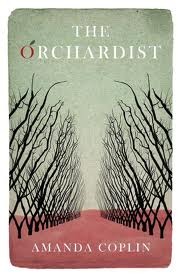
The Orchardist - Amanda Coplin


'He had one of those complicated faces that one had to consider at length to understand how emotion lay on it, to understand it at all.'

The setting is north-west America at the beginning of the twentieth century, and William Talmadge, known just as Talmadge, works alone on his remote orchard, having established it with, and then inherited it from, his mother when she passed away. His father had earlier died in a mining accident. Talmadge is ‘a gentle, unassuming orchardist from the mountains’, and his is a peaceful, gentle and fairly solitary life, just occasional visitors like Clee the native American wrangler, and a friend in the town, the midwife and herbalist Caroline Middey, but one day this all changes when two young pregnant girls are seen in the town, stealing his fruit when he is at the market, and then he finds them hiding on his land. He is a kind man, and wants to help them and shield them, realising they are rather wild, in trouble and have been treated harshly in their lives thus far. His sister Elsbeth disappeared some years before and he still feels her absence deeply; 'Talmadge was stuck in grief he only partially acknowledged...the festering issue was Elsbeth's disappearance, which his mind could not accept, could not swallow; and so he suffered always and abstractedly...'

The two girls, Jane and Della, have evidently been ill-treated in their life prior to meeting Talmadge; the men they had been with 'had taught them both that you could read nothing definitive in a man's face, even if he appeared kind. Kind could turn on its head instantly; could throttle you, or hit you across the face with the back of a hand.'

Talmadge’s life is never really quite the same again once he has let the girls into it. With them comes trouble, but also a fatherly affection and concern that drives him to new lengths; before his trees and the produce was all that he nurtured. For him there is the contrast of ‘the happiness of company, the anxiety of interrupted solitude.’

I admit that when I started reading this novel, I was interested but not initially gripped. It is written in a very particular style, with an omniscient narrator recounting the story. The writing is gentle and suits the pace and tone of the story. Once I was beyond about 150 pages though, I found I was really involved with the tale and there was no question that I would put it down then; it grew into an absorbing story and the characters wove their way into my thoughts and touched my heart. Though it is a quiet book in many ways, it contains some shocking, painful and dramatic events. The story spans many years and becomes rather epic in scale.

This is a moving, thoughtful and rather haunting novel. Amanda Coplin tackles some fundamental themes about life in this book, about humans and our purpose. At one stage Della, one of the girls, now older, asks herself ‘Why are we born?...What does it mean to be born? To die?’

Through the story the author comments on the intrusion of the modern world, observing the changes in travel and work, from the wagon to the train and from small to large-scale distribution of the fruit, which seems strange to Talmadge and which he tries to resist.

I’m not sure if my words have done this book justice or conveyed well enough how I felt about it. I will just finish by saying I deeply admired the storytelling, the nuances and the observations on the fragility of life, the details of the landscape and the orchard, and the attempted, well-intentioned heroics of one man who can’t save everyone. I grew more and more entranced by the tale as it went on, and looking back I am very glad to have read it. 


Published by Weidenfeld and Nicholson


Thursday, 1 August 2013

Indiscretion - Charles Dubow


'Carelessness is the handmaiden to tragedy. Cataclysmic events often have their origins in the mundane. We turn left when we had meant to go right, and the world changes forever.'

Harry and Madeleine (Maddy) Winslow are a beautiful, charming couple in their forties living an enviable and very comfortable life. Harry is a successful, award-winning writer and Madeleine is his charismatic, warm and admired wife, and attentive mother to their fragile son, Johnny. We meet them in their home in the Hamptons, but they also spend time abroad in Rome and at their home in Manhattan. Everything speaks of ease, wealth, and a good life. They attract others who enjoy being in their company and basking in the glow that seems to emanate around them. One weekend, a woman in her twenties named Claire travels over from New York City to the Hamptons, invited by a boyfriend, and meets Harry and Maddy whilst there. Having met them, she is entranced by the couple and their lives and world. 'It's hard not be caught up in the beauty of life from a summer lawn in the Hamptons', we are told. It is when this attraction and excitement becomes a stronger sort of desire that danger starts to loom on the horizon, and then one night, there is a conversation, nothing more, but Walter warns us that the 'wax seal of a secret letter has been broken. Nothing can make it whole again.'

There are four main characters here though, and the fourth of them is the one who is telling this story. Walter Gervais grew up next door to Maddy and has always loved her; to Maddy they are the best of friends but nothing more. 

'Every story has a narrator. Someone who writes it down after it's all over. Why am I the narrator of this story? I am because it is the story of my life - and of the people I love most. I have tried to be as scrupulous as possible in my telling of it. I wasn't a participant in everything that happened, but after I knew the ending, I had to fill in the missing pieces...'

In Walter, a very memorable narrator has been created. He guides us through the story that he himself is so intricately involved in. For me, he made it a compelling read. Despite his words above though, I was reminded of the words of the novel's prologue, how we can be guilty of 'casting a roseate glow over our memories. Some memories burn brighter, whether because they meant more or because they have assumed greater importance in our minds...' and he goes on to advise that 'I have forgotten so much ...and to fill in the gaps, I conflate the past or make it up entirely...After a while it becomes real.'

This distinctive, involved and biased omniscient narrator had my attention throughout, and had my belief despite my reasons to doubt his reliability sometimes. It's been mentioned that 'the narrator is akin to Nick Carraway in The Great Gatsby', and I feel this is a fair comparison in some ways. 

The author sets the scene, illustrating the established friendships and allowing the newcomer Claire to gradually become part of their lives. As the narrative progresses, the suspense increases and I began to feel an impending sense of the sadness that was surely to come as a result of what happens, but like a voyeur I couldn't look away; I was too engrossed by this tangle of lives which was becoming increasingly, inextricably messy. 

I formed pictures of the main four characters in my mind's eye from the rich way they were described; they became fully formed, human and deeply flawed. At times I found these creations attractive and enviable, but I also despaired of them and judged them harshly.  Through them the writer cleverly spins an entrancing yet cautionary tale of the different ways in which humans love. 

It's an emotional read, with lives that are ostensibly full, with much wealth and successful careers, a feeling of looking in, via Walter, on how the other half lives (including him), yet in Walter's case there is such emotional emptiness. For Claire there is the eagerness of youth seeking out new experiences; the author really captures the urge to be part of something, and the sense that feelings and desire are everything, dominating the life and thoughts of someone at that stage of their life, with no responsibilities and only a short-term outlook. There is a marriage between two golden people, and a friendship and trust that seems so strong. Their marriage is at the heart of this tale throughout. There are passionate, sexy episodes that were convincing; human desire that rises above all sensible, rational reason. 

The novel speaks of the contentment that we think we have in life, or even actually have, and yet that element of human nature, the flaw that means we experience a nagging greed for something else that seems to be missing, that is different and appealing, and yet it often leaves us unhappy even if we reach for it, and we realise the true value and worth of what we already had; 'We want what we want. The bitter truth is that it rarely makes us happy once we get it.' I can't write about what happens here without including a spoiler, but you'll see, when you read. 

I read this story very quickly, gulping down the story and swiftly turning the pages. I had to know how it would all end. I was sad at how it all ended, in fact I felt quite drained after all the emotion. Part of me wonders at a different ending but perhaps what happened was what had to happen.

I thought this was a brilliant, captivating and addictive debut novel, about beautiful people with seemingly perfect lives, and what results when an outsider breaks in on all this and exposes the weakness, changing it irrevocably. It made me think a lot about people and how they behave. It's about love and families, contentment versus temptation, friendship and unrequited love, wealth and envy, greed and lust, fate, guilt and tragedy. I enjoyed it very much indeed. 

Published by William Morrow Paperbacks*

Thanks to the tour host and publisher for sending a copy of this novel to read and give an honest review.


About the author:

Charles Dubow was born in New York City and spent his summers at his family’s house on Georgica Pond in East Hampton. He was educated at Wesleyan University and New York University. He has worked as a roustabout, a lumberjack, a sheepherder in New Zealand, and a congressional aide, and was a founding editor of Forbes.com and later an editor at Businessweek.com. He lives in New York City with his wife, Melinda; children, William and Lally; and Labrador retriever, Luke. This is his first novel.
You can find the author on twitter @CharlesDubow


*UK readers, please note - this novel is published in the UK too, by Blue Door, but I have featured the US cover and publisher as this is the edition I have read in this instance and the edition featured in the book tour I am taking part in. 


Friday, 26 July 2013

Book Beginnings (6) - The Orchardist - Amanda Coplin


Gilion at Rose City Reader hosts Book Beginnings on Fridays


The idea, as stated on the host's blog, is 'to share the first sentence (or so) of the book you are reading, along with your initial thoughts about the sentence, impressions of the book, or anything else the opener inspires.' There's a hash tag #BookBeginnings for twitter etc too, and a master linky list on the host's blog. I've got a couple of books on the go at the moment so I've just picked one out to mention here.


My Book Beginning

The Orchardist by Amanda Coplin


Published by Weidenfeld & Nicolson


'His face was pitted as the moon. He was tall, broad-shouldered, and thick without being stocky, though one could see how he would pass into stockiness; he had already taken on the barrel-chested sturdiness of an old man. His ears were elephantine, a feature most commented on when he was younger, when the ears stuck out from his head; but now they had darkened like the rest of his sun-exposed flesh and lay agains his skull more than at any other time in his life, and were tough, the flesh granular like the rind of some fruit.'


What an intimate and detailed first few lines, quite vividly introducing the man who will be the main character in the novel. I've just started this one and it's beautifully written so far. 


Here's the synopsis from goodreads:

At the turn of the 20th century in a rural stretch of the Pacific Northwest, a solitary orchardist, Talmadge, tends to apples and apricots as if they were loved ones. A gentle man, he's found solace in the sweetness of the fruit he grows and the quiet, beating heart of the land he cultivates. One day, two teenage girls appear and steal his fruit from the market and later return to the outskirts of his orchard to see the man who gave them no chase. Feral, scared, and very pregnant, the girls take up on Talmadage?s land and indulge in his deep reservoir of compassion. Just as the girls begin to trust him, men arrive in the orchard with guns, and the shattering tragedy that follows will set Talmadge on an irrevocable course not only to save and protect but to reconcile the ghosts of his own troubled past. Transcribing America as it once was before railways and roads connected its corners, Coplin has woven a tapestry of secluded people who come together in the wake of unspeakable cruelty and misfortune. She writes with breathtaking precision and empathy, and in THE ORCHARDIST has crafted an astonishing debut novel about a man who disrupts the lonely harmony of an ordered life when he opens his heart and lets the world in.